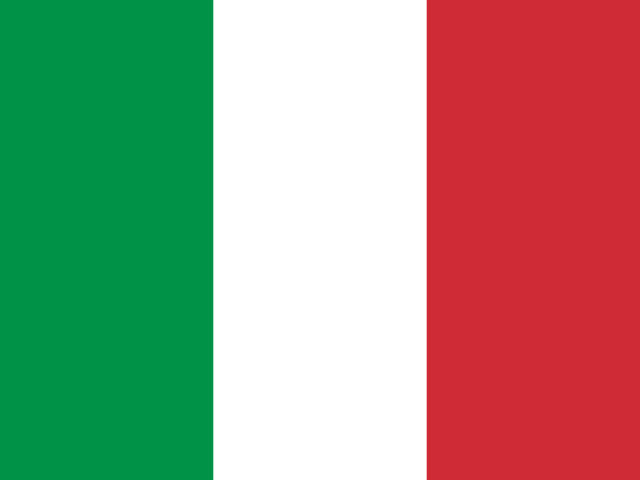
 Italy
Italy ranks #16 of 242 on the Composite Power Index (7.4/100), scored on military spending, active personnel, nuclear arsenal, economic size and logistics. Its Instability Index is 16.6/100 (#149 most fragile). Every figure below carries its source and year. Data read 2026-10-22.
Analyst briefing
Italy: Moderate Debt, Mid-Tier Military Outlay, Strong State Capacity
Italy's economy totaled $2.38 trillion in 2024, with per-capita output of $40,385 and a population of about 58.95 million, per World Bank WDI figures.
Fiscal Position
The IMF's World Economic Outlook puts Italian government debt at 138.4 percent of GDP for 2026 — high relative to most of the countries in this dataset, though below Japan's ratio. Foreign reserves were $89.71 billion in 2025, per IMF IFS data, a reserve position well below Japan's but larger than several smaller economies assessed alongside Italy in this batch.
Military Spending
SIPRI's 2025 figures put Italian military expenditure at $48.14 billion, equal to 1.889 percent of GDP under SIPRI's own GDP series. That ratio should not be recomputed against the World Bank's $2.38 trillion GDP figure above, since the two series differ. Active personnel numbered 161,000 in 2022, per COW NMC, which scores Italy's CINC at 0.00964 for that year.
Governance
V-Dem's 2025 data scores Italy at 0.745 on electoral democracy and 0.642 on liberal democracy — a gap between the two measures of roughly 0.1, suggesting electoral competition outpaces liberal constraints somewhat, per V-Dem's framework. State capacity is scored at 0.865, a figure that sits above both democracy measures and indicates administrative and enforcement capacity ahead of the liberal-constraints score specifically.
Energy
Italy's primary energy consumption was 6.11 exajoules in 2024, and electricity generation reached 264.7 terawatt-hours in 2025, per Our World in Data. Domestic oil production was 51.815 terawatt-hours and gas production 28.001 terawatt-hours, both for 2024 — current relative to the other 2024-2025 figures in this file, unlike several other countries in this batch where production data is older.
Military Capability Context
COW NMC's CINC score of 0.00964 for Italy in 2022 is a composite capability index incorporating military, demographic and industrial components; on its own it does not translate directly into the SIPRI spending figures above, which are drawn from a separate dataset and methodology.
Data Gaps
No metrics are missing for Italy in this dataset; all figures carry current-to-near-current years (2024-2026).
Sources: World Bank WDI, IMF WEO, IMF IFS, SIPRI Milex, COW NMC, V-Dem v15, Our World in Data (Energy)
Written from the sourced figures on this page and checked against them before publication — any figure not present in the data blocks the briefing. Generated 2026-10-06.
What drives the instability score
Capability and economy · click a metric to compare
CINC is a composite index (already contains military spending, personnel, energy & population) — shown for reference; it is not added into the Composite Power Index to avoid double-counting. Each figure carries its own source year; vintages can differ.
Capability profile
Trajectory
Governance
Energy
Strategic Relationships
Allies (27)
- Polanddefense 1999
- Czechiadefense 1999
- Hungarydefense 1999
- Greecedefense 1992
- Germanydefense 1990
- Portugaldefense 1988
- Spaindefense 1988
- Maltadefense 1980
- Luxembourgdefense 1954
- Netherlandsdefense 1954
- Belgiumdefense 1954
- Francedefense 1954
- United Kingdomdefense 1954
- Türkiyedefense 1951
COW alliance ties — includes historical pacts; defense first.
Neighbours (19)
Disputes (154)
COW Dyadic MID, 1816–2014 — historical register, not live rivalries. Count = militarized disputes; year = most recent; ● = peak intensity.
Signals
Conflict forecast (ViEWS, 2029-04-01): 0% risk
Arms imports (SIPRI Arms Transfers, 2025): 9 transfers
52% of imports from United States — supplier dependence
Displacement (UNHCR): 266 refugees originated · 0 IDPs · 192.9K hosted
 Albania
 Austria
 Switzerland
 Germany
 Algeria