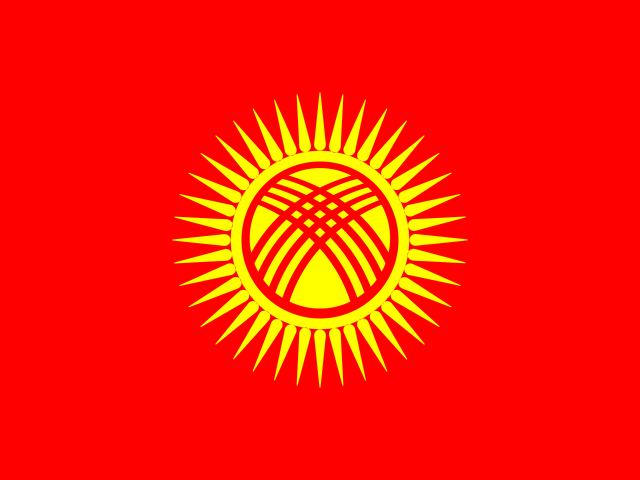
 Kyrgyzstan
 ranks #148 of 242 on the Composite Power Index (0.2/100), scored on military spending, active personnel, nuclear arsenal, economic size and logistics. Its Instability Index is 29.6/100 (#78 most fragile). Every figure below carries its source and year. Data read 2026-10-22.
Analyst briefing
Kyrgyzstan: Low-Income Economy Carrying a Defense Budget Near 3 Percent of GDP
Kyrgyzstan's GDP stood at $17.48 billion in 2024, with GDP per capita of $2,420 and a population of 7,221,868, according to World Bank WDI data. Governance indicators from V-Dem's 2025 wave show an electoral democracy score of 0.313 and a liberal democracy score of 0.178, with state capacity at 0.353 — all in the lower portion of V-Dem's 0-1 scale.
SIPRI's 2025 Milex data put military expenditure at $601.1 million, or 2.917 percent of GDP under SIPRI's own GDP series; that ratio is sourced directly from SIPRI and is not derived from the World Bank GDP figure cited above. The Correlates of War National Material Capabilities dataset recorded 11,000 active-duty personnel in 2022 and a CINC score of 0.00044674426 for the same year.
On fiscal and external position, the IMF's World Economic Outlook projects government debt at 37.4 percent of GDP for 2026, while IMF International Financial Statistics data recorded reserves of $1.82 billion as of 2024. Taken together, the debt projection and the reserves figure describe a government balance sheet carrying moderate leverage against a currency buffer reported a year earlier, though no debt-service or import-cover ratio is present in this bundle to carry that observation further.
The Correlates of War CINC score, while small in absolute terms, is a relative-share measure spanning the entire international system rather than a regional one, so it should be read as Kyrgyzstan's fractional share of global material capability in 2022 rather than as a standalone strength indicator.
Energy
Our World in Data figures show primary energy consumption of 0.2058 exajoules in 2023 and electricity generation of 15.78 terawatt-hours in 2025. Oil and gas production are both recorded in the same source at 0.631 and 0.295 terawatt-hours respectively, but both figures are dated 2016, nearly a decade out of date, and should not be treated as current output levels.
Data Gaps
The oil and gas production figures above are the most significant gap in this bundle: a 2016 dateline on energy-production series means they cannot speak to Kyrgyzstan's current hydrocarbon output. The reserves figure dates to 2024, the same year as the GDP and population series, and the 2026 government debt figure is an IMF projection rather than a realized outturn. No conflict-event, alliance, or armed-forces equipment data appear in this bundle.
Sources: World Bank WDI, IMF WEO, IMF IFS, SIPRI Milex, Correlates of War NMC, V-Dem v15, Our World in Data (Energy).
Written from the sourced figures on this page and checked against them before publication — any figure not present in the data blocks the briefing. Generated 2026-10-06.
What drives the instability score
Capability and economy · click a metric to compare
CINC is a composite index (already contains military spending, personnel, energy & population) — shown for reference; it is not added into the Composite Power Index to avoid double-counting. Each figure carries its own source year; vintages can differ.
Capability profile
Trajectory
Governance
Energy
Strategic Relationships
Allies (12)
- Moldovadefense 1995
- Turkmenistandefense 1995
- Ukrainedefense 1995
- Armeniadefense 1995
- Azerbaijandefense 1995
- Belarusdefense 1995
- Georgiadefense 1995
- Uzbekistannonaggression 2001
- Russianonaggression 1996
- Tajikistannonaggression 1996
- Chinanonaggression 1996
- Kazakhstannonaggression 1996
COW alliance ties — includes historical pacts; defense first.
Neighbours (4)
Disputes (10)
COW Dyadic MID, 1816–2014 — historical register, not live rivalries. Count = militarized disputes; year = most recent; ● = peak intensity.
- Tajikistan2× · 2014
- Uzbekistan6× · 2013
- Afghanistan2× · 1997
Signals
Conflict forecast (ViEWS, 2029-04-01): 0% risk
Arms imports (SIPRI Arms Transfers, 2023): 5 transfers
57% of imports from Türkiye — supplier dependence
Displacement (UNHCR): 3.3K refugees originated · 0 IDPs · 1.2K hosted
Compare Kyrgyzstan with
 China
 Kazakhstan
 Tajikistan
 Uzbekistan
 United States
Neighbours and leading powers — each links to its own sourced dossier.