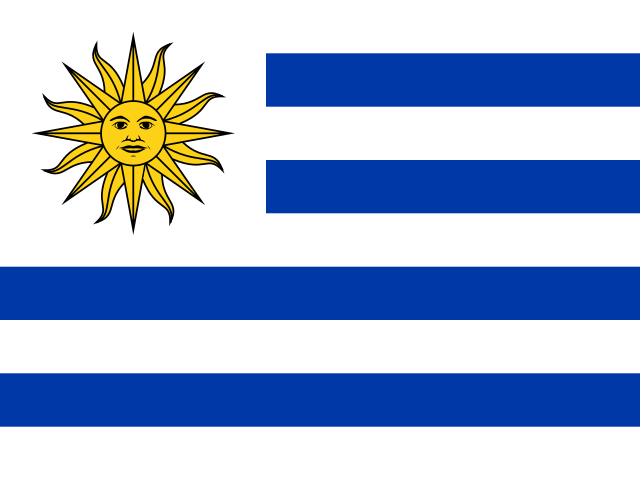
 Uruguay
 ranks #100 of 242 on the Composite Power Index (0.5/100), scored on military spending, active personnel, nuclear arsenal, economic size and logistics. Its Instability Index is 15/100 (#159 most fragile). Every figure below carries its source and year. Data read 2026-10-22.
Analyst briefing
Uruguay: Stable Democratic Institutions, Modest Defense Outlays
Uruguay's economy was valued at $80.96 billion in 2024, with per-capita output of $23,906.51, on a population of 3,386,588, per World Bank WDI figures. Government debt is projected at 66.8% of GDP in 2026, per IMF WEO, a figure that reflects the IMF's own forward-looking fiscal projection rather than a historical outturn. Reserves stood at $18.98 billion in 2025, per IMF IFS, a separate figure drawn from a different year and source than the debt projection, so the two should not be read as a single balance-sheet snapshot.
Defense Posture
SIPRI Milex data put Uruguay's military spending at $1.95 billion in 2025, equivalent to 2.284% of GDP by SIPRI's own GDP series for that year. Active personnel numbered 21,000 in 2022, per COW NMC, with a composite index of national capability (CINC) of 0.00041140229 for the same year, also per COW NMC.
Governance
Uruguay's V-Dem v15 scores for 2025 are strong across the board: an electoral democracy index of 0.862, a liberal democracy index of 0.79, and a state capacity score of 0.945. Together these point to a well-institutionalized, liberal electoral system with substantial administrative reach, per V-Dem's framework. All three scores are drawn from the same V-Dem v15 release and the same reference year, 2025, so they can be read as a single coherent governance snapshot rather than figures pieced together from different vintages.
Energy
Primary energy consumption was 0.1636 exajoules in 2023, per Our World in Data's energy series, with electricity generation at 11.94 terawatt-hours in 2025 from the same source.
Data Gaps
Both oil and gas production are recorded at 0.0 terawatt-hours, but that figure dates to 2016, per Our World in Data — nearly a decade old. No more recent production series is available in this bundle, so the current state of domestic hydrocarbon output cannot be assessed from these figures alone. The 2.284% milex/GDP figure should be read against SIPRI's own GDP series for 2025 only; it is not derived from, and should not be compared against, the World Bank's $80.96 billion GDP figure for 2024, which uses a different year and methodology.
Sources: World Bank WDI, IMF WEO, IMF IFS, SIPRI Milex, COW NMC, V-Dem v15, Our World in Data (Energy).
Written from the sourced figures on this page and checked against them before publication — any figure not present in the data blocks the briefing. Generated 2026-10-06.
What drives the instability score
Capability and economy · click a metric to compare
CINC is a composite index (already contains military spending, personnel, energy & population) — shown for reference; it is not added into the Composite Power Index to avoid double-counting. Each figure carries its own source year; vintages can differ.
Capability profile
Trajectory
Governance
Energy
Strategic Relationships
Allies (34)
- Belizedefense 1991
- Guyanadefense 1991
- Canadadefense 1989
- St. Kitts and Nevisdefense 1984
- Bahamasdefense 1982
- St. Vincent and the Grenadinesdefense 1981
- Antigua and Barbudadefense 1981
- Dominicadefense 1979
- St. Luciadefense 1979
- Surinamedefense 1977
- Grenadadefense 1975
- Jamaicadefense 1969
- Barbadosdefense 1967
- Trinidad and Tobagodefense 1967
COW alliance ties — includes historical pacts; defense first.
Disputes (9)
COW Dyadic MID, 1816–2014 — historical register, not live rivalries. Count = militarized disputes; year = most recent; ● = peak intensity.
- Argentina3× · 1973
- Norway1× · 1973
- Germany3× · 1945
- Japan1× · 1945
- United Kingdom1× · 1939
Signals
Conflict forecast (ViEWS, 2029-04-01): 0% risk
Arms imports (SIPRI Arms Transfers, 2025): 2 transfers
31% of imports from United States — supplier dependence
Displacement (UNHCR): 126 refugees originated · 0 IDPs · 3.2K hosted
 Argentina
 Brazil
 United States
 China
 Russia