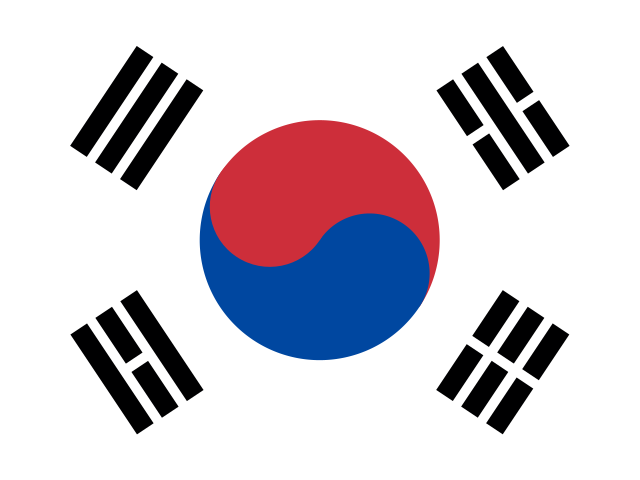
 South Korea
 ranks #11 of 242 on the Composite Power Index (9.3/100), scored on military spending, active personnel, nuclear arsenal, economic size and logistics. Its Instability Index is 15.6/100 (#155 most fragile). Every figure below carries its source and year. Data read 2026-10-22.
Analyst briefing
South Korea: Steady Economic Weight, Moderate Military Spending Share
South Korea's economy was worth $1.9 trillion in 2024, per the World Bank's WDI figures, with GDP per capita at $36,239 and a population of 51.8 million the same year. The IMF's WEO projects government debt at 54.4% of GDP in 2026.
Military and Fiscal Position
SIPRI's 2025 figures put South Korean military expenditure at $47.8 billion, equivalent to 2.601% of GDP under SIPRI's own GDP series. That share should not be recalculated against the World Bank's GDP figure above, since the two series are not interchangeable. The IMF's IFS data show reserves of $423.3 billion in 2025.
On manpower, the Correlates of War National Material Capabilities (COW NMC) dataset lists 555,000 active personnel as of 2022, with a composite index of national capability (CINC) score of 0.0200 for the same year — one of the higher scores among the countries tracked here, reflecting South Korea's combined population, military and industrial base as COW measures it.
Governance
V-Dem's 2025 (v15) scores rate South Korea at 0.819 on the electoral democracy index and 0.739 on liberal democracy, with a state capacity score of 0.917 — indicating strong administrative and institutional capability by V-Dem's measure.
Energy
Per Our World in Data's energy figures, South Korea consumed 13.0 exajoules of primary energy in 2024 and generated 624.66 terawatt-hours of electricity in 2025. Domestic oil production was recorded at 0.0 TWh and gas production at 1.786 TWh, but both figures date to 2016 — a decade old — and say nothing about current domestic output levels. Set against electricity generation of 624.66 TWh in 2025, the near-absence of recorded domestic oil and gas production, even allowing for the age of that figure, is consistent with a generation base that depends heavily on imported fuel or other sources not broken out in this dataset.
Summary
Taken together, the figures describe an economy of substantial size — $1.9 trillion per the World Bank — with military spending, at $47.8 billion per SIPRI, that is sizable in absolute dollar terms but a middling share of SIPRI's own GDP measure at 2.601%. The personnel figure of 555,000 and CINC score of 0.0200, both from COW NMC and dated 2022, point to one of the larger standing militaries among the countries covered in this batch. V-Dem's current governance scores place South Korea solidly in the high range on both electoral and liberal democracy, with a state capacity score of 0.917 indicating strong institutional reach. The clearest data gap is on energy production, where the only figures available are nine years old.
Sources: World Bank WDI; IMF WEO; IMF IFS; SIPRI Milex; COW NMC; V-Dem v15; Our World in Data (Energy).
Written from the sourced figures on this page and checked against them before publication — any figure not present in the data blocks the briefing. Generated 2026-10-06.
What drives the instability score
Capability and economy · click a metric to compare
CINC is a composite index (already contains military spending, personnel, energy & population) — shown for reference; it is not added into the Composite Power Index to avoid double-counting. Each figure carries its own source year; vintages can differ.
Capability profile
Trajectory
Governance
Energy
Strategic Relationships
Allies (2)
- United Statesdefense 1953
- North Koreanonaggression 1991
COW alliance ties — includes historical pacts; defense first.
Neighbours (4)
Disputes (74)
COW Dyadic MID, 1816–2014 — historical register, not live rivalries. Count = militarized disputes; year = most recent; ● = peak intensity.
- North Korea31× · 2014
- China15× · 2014
- Russia9× · 2014
- Japan15× · 2012
- Spain1× · 2003
- Vietnam1× · 1973
- Cambodia1× · 1967
- United Kingdom1× · 1898
Signals
Conflict forecast (ViEWS, 2029-04-01): 0% risk
Arms imports (SIPRI Arms Transfers, 2025): 8 transfers
62% of imports from United States — supplier dependence
Displacement (UNHCR): 117 refugees originated · 0 IDPs · 4.4K hosted
Compare South Korea with
 China
 Japan
 North Korea
 Russia
 United States
Neighbours and leading powers — each links to its own sourced dossier.