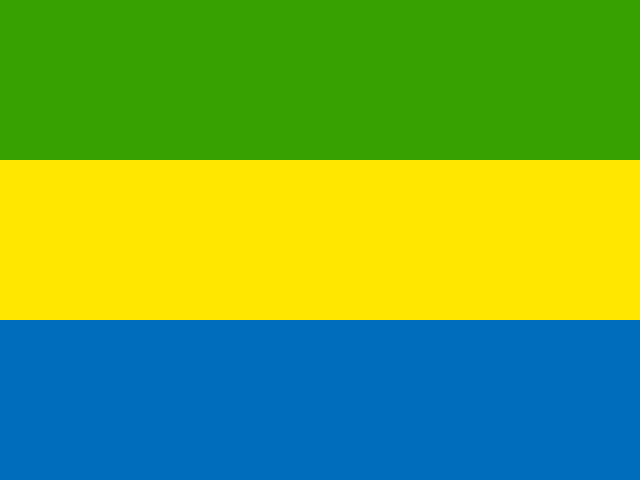
 Gabon
Gabon ranks #125 of 242 on the Composite Power Index (0.3/100), scored on military spending, active personnel, nuclear arsenal, economic size and logistics. Its Instability Index is 24.1/100 (#109 most fragile). Every figure below carries its source and year. Data read 2026-10-22.
Analyst briefing
Gabon
Gabon's economy was valued at $20.90 billion in 2024, per World Bank WDI figures, with GDP per capita of $8,230.04 and a population of 2,538,952 that year. Government debt is projected at 86.1% of GDP for 2026, according to IMF WEO data — a high debt load relative to the size of the economy. Foreign reserves stood at $638.79 million in 2024, per World Bank WDI figures.
Defense spending totaled $356.11 million in 2025, according to SIPRI's Milex database, equivalent to 1.662% of GDP under SIPRI's own GDP accounting for that year — a ratio drawn from SIPRI's parallel GDP series rather than the World Bank total cited above. The Correlates of War National Material Capabilities (COW NMC) dataset recorded 5,000 active military personnel in 2022 and assigned Gabon a composite index of national capability (CINC) score of 0.00020991577 for that year.
V-Dem v15's 2025 governance indicators show an electoral democracy score of 0.302, a liberal democracy score of 0.178, and a state capacity score of 0.416 — a state capacity reading markedly higher than either democracy measure on this scale, suggesting administrative functioning that outpaces electoral or liberal institutional strength by these particular metrics.
Energy data show a sharp contrast between fuels. Primary energy consumption was 0.0579 exajoules in 2023 and electricity generation 2.6 terawatt-hours in 2024, per Our World in Data. Oil production stood at 130.434 terawatt-hours in 2024 — a current-year figure, and a large one relative to the country's own electricity generation and primary energy figures above — while gas production of 4.111 terawatt-hours is dated 2016, per the same source.
Data gaps
The gas production figure (4.111 terawatt-hours) is nearly a decade stale, dated 2016 per Our World in Data, and should not be compared directly against the 2024 oil production figure from the same source. The 86.1% debt-to-GDP figure is an IMF WEO projection for 2026 rather than a confirmed historical outturn. No generation-mix figures accompany the electricity data above, so the composition of Gabon's domestic power supply cannot be assessed from this bundle despite its large recorded oil output.
Sources: World Bank WDI, IMF WEO, SIPRI Milex, Correlates of War National Material Capabilities, V-Dem v15, Our World in Data (Energy)
Written from the sourced figures on this page and checked against them before publication — any figure not present in the data blocks the briefing. Generated 2026-10-06.
What drives the instability score
Capability and economy · click a metric to compare
CINC is a composite index (already contains military spending, personnel, energy & population) — shown for reference; it is not added into the Composite Power Index to avoid double-counting. Each figure carries its own source year; vintages can differ.
Capability profile
Trajectory
Governance
Energy
Strategic Relationships
Allies (19)
- Equatorial Guineadefense 2000
- Rwandadefense 2000
- Sao Tome and Principedefense 2000
- Chaddefense 2000
- Angoladefense 2000
- Burundidefense 2000
- Central African Republicdefense 2000
- Cameroondefense 2000
- DR Congodefense 2000
- Congo Republicdefense 2000
- Togodefense 1963
- Madagascardefense 1961
- Mauritaniadefense 1961
- Nigerdefense 1961
COW alliance ties — includes historical pacts; defense first.
Disputes (3)
COW Dyadic MID, 1816–2014 — historical register, not live rivalries. Count = militarized disputes; year = most recent; ● = peak intensity.
- Cameroon1× · 1976
- Equatorial Guinea1× · 1972
- France1× · 1964
Signals
Conflict forecast (ViEWS, 2029-04-01): 0% risk
Arms imports (SIPRI Arms Transfers, 2024): 2 transfers
33% of imports from China — supplier dependence
Displacement (UNHCR): 984 refugees originated · 0 IDPs · 166 hosted
Compare Gabon with
 Angola
 Cameroon
 Congo Republic
 Equatorial Guinea
 Nigeria
Neighbours and leading powers — each links to its own sourced dossier.